DO THESE Exercises and Readings BEFORE the next class. There might not be any correct answers. Itís the thinking process that is valuable as such.
|
TIME |
THEMES AND HOMEWORK |
|||||||||||||||||||||||||||||||
|
What is Knowledge? |
THEORY OF KNOWLEDGE Exercise 1.1.: Try to divide the following statements about somebody having (or not having) some knowledge into three groups, according to what the knowledge consists of. a.Everybody knows that the earth is round. b.''Lloyd George knew my father, my father knew Lloyd George.'' c.They haven't been here long and know only a little English. d.He doesn't know his left foot from his right foot. e.I know when the train is due to arrive. f.Having been there many times, she knows Italy well. g.I don't know how to drive a car, h.... but I know that one has to press the clutch to change gear. i.Nobody here knows how old the Principal is. Judging by how you divided the sentences into three groups - what three meanings can "to know" take in English? READING 1: WHAT IS PROPOSITIONAL KNOWLEDGE? What is known in 'knowledge that' is a proposition, expressed in the clause which, (in the most obvious cases at least,) follows the word ''that'' A proposition is what different sentences, even in different languages, with the same meaning have in common (B. Russell, 1862-1970.) Propositions are capable of being true or false: this distinguishes them from promises, questions, commands, proposals, etc., (which like propositions are expressed in sentences.)
Exercise 2.2.: Which of the following sentences express propositions? What kind of sentences are those that do not? a.You shouldn't waste food. b.I think you shouldn't waste food. c.What a waste of food! d.The amount of food wasted is about 20% of what is used. e.I hereby propose that we reduce the amount of food we waste. f.Is there really so much waste of food? g.The amount of food wasted is tremendous! h.Waste not, want not. i.What we waste we did not deserve in the first place. j.Does everyone feel as bad about food wasted as we do? READING 2: KNOWLEDGE AND INFORMATION KNOWLEDGE One aspect of knowing, that which conventionally comes from ''study, investigation, observation or experience'' (Websterís, 1986.) Knowledge comes both from direct experience and from information provided by others. Some psychologists discern three types of knowledge: ''Propositional knowledge is knowledge of facts or truths stated in propositions; it is entirely language-dependent. Practical knowledge is knowing how to do something, as exemplified in the exercise of some special skill or proficiency. Experiential knowledge is knowing some entity by direct face-to-face encounter with her/him/it; it is direct discrimination of what is present in relation with the knower'' (John Heron, 1981, quoted in John Rowan, 1983.) INFORMATION Ours is a society based on information -- far too much of it for most of us, pushing us into 'information overload' (Alvin Toffler, 1970) and persuading us that information, even information for its own sake, always has value: ... ''We are drowning in information but starved for knowledge'' (John Naisbitt, 1984.) NOTE! Email your answers to the exercises above now toalex@alexmorgan.com |
|||||||||||||||||||||||||||||||
|
Foundations
of Knowledge |
FOUNDATIONS OF KNOWLEDGE
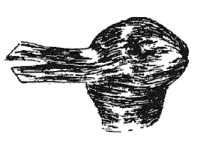
Look at the picture below. What are the two ways of "seeing" the picture? What does this tell about perception?
Exercise Two Human beings are usually said to have five senses. a.List the usual five senses and their sense organs, and make further subdivisions if appropriate. b.Try to decide on an order of the five senses, according to how essential they are for our functioning in the world. c.Some people claim that we could have Extra Sensory Perceptions (ESP) such as mind reading, clairvoyance etc. Does the concept of ESP make sense? Why / Why not? READ more about today's topic in your lecture notes and see some more illusions here http://www.illusionworks.com/). 2. Memory a.
recall Try to give a more detailed description of what these involve and an example from your own experience of each of these. A distinction commonly made, (e.g. in the two-process model of Atkinson and Shiffrin, 1968,) is that between sensory, short-term and long-term memory. Sensory memory gives us an accurate account of the environment 3. Language Language can be value-laden i.e. depending a certain type of language and choice of words contains value judgements. We can play different language games (Wittgenstein) by using language in this way. Some linguistists such as Noam Chomsky believe that all languages have universal structures (universal grammar) and that people have innate ability to learn language. NOTE! Email your answers to exercises above now to alex@alexmorgan.com |
|||||||||||||||||||||||||||||||
|
Rationality
and Logic |
RATIONALITY AND LOGICIntroduction Rationality. A person is said to be rational when he adopts beliefs for appropriate reasons or behaves in a way that "makes sense" given certain objectives or goals. Aristotle believed that the main feature the distinguished humans from other animals were their capacity to reason - to be rational. The word "rational" can be used to describe behavior, beliefs, arguments and policies if they make sense or are appropriate to achieve some goal. Opposite of rational is irrational - for example if I freak out while giving the lecture about theory of knowledge it would be appropriate to say that I am irrational because my behavior does not help to achieve the aims of the lecture. Only rational agents such as humans can be irrational. Entities that have no capacity of reason, such as rocks and trees, are said to be non-rational. Logic (Greek logos,"word,""speech,""reason") is a science dealing with the principles of valid reasoning and argument. There are two types of logic (a) deductive and (b) inductive. Inductive logic means making generalizations of a limited number of exemplar - for example "since all my boyfriend have been horrible chauvinist - I can only conclude that men are pigs." It is clear that inductive logic never give us 100 % certainty - it could well be that the next man this woman meets is absolutely wonderful, handsome, rich, modest, considerate, flamboyant yet humble kind of figure that the woman will love forever. In the following we concentrate on deductive logic which tries to determine the conditions under which one is justified in passing from given statements, called premises, to a conclusion that is claimed to follow from them. Logical validity is a relationship between the premises and the conclusion such that if the premises are true then the conclusion is true. The validity of an argument should be
distinguished from the truth of the conclusion. If one or more of the
premises is false, the conclusion of a valid argument may be false. For
example, "All mammals are four-footed animals; all people are mammals;
therefore, all people are four-footed animals" is a valid argument with
a false conclusion. On the other hand, an invalid argument may by chance have
a true conclusion. "Some animals are two-footed; all people are animals;
therefore, all people are two-footed" happens to have a true conclusion,
but the argument is not valid. Logical validity depends on the form of the
argument, not on its content. If the argument were valid, some other term
could be substituted for all occurrences of any one of those used and
validity would not be affected. By substituting "four-footed" for
"two-footed," it can be seen that the premises could both be true
and the conclusion false. Thus the argument is invalid, even though it has a
true conclusion. All A's are B's" (universal
affirmative) The letters stand for common nouns, such as "dog,""four-footed animal,""living thing," which are called the terms of the syllogism. A well-formed syllogism consists of two premises and a conclusion, each premise having one term in common with the conclusion and one in common with the other premise. In classical logic, rules are formulated by which all well-formed syllogisms are identified as valid or invalid forms of argument. Exercise 1 Which of the following is a VALID argument
3. Truth tables A formal system of logic enables us to see whether an argument is valid, i.e. whether the truth of the premises guarantees the truth of the conclusion, regardless of the content of the propositions. A syllogism, as we have seen, is an argument of a standard format, with the two premises and the conclusion being all of the same form, such as: ''some A are B,'' for instance. In propositional logic, on the other hand, the basic constituents are simple propositions which are combined into more complex propositions by means of logical words, like ''not'' and ''and''. For example, in the proposition. The logical form of a complex proposition consists of i.propositional
variables: ii.logical
connectives: Using these symbols for the logical connectives, the logical form of the above proposition can be written as p & q => p . (Note that in logic, as in mathematics, ''or'' always has an inclusive meaning: so ''p v q'' means ''p or q, or both.'') Exercise 2. Using the logical connectives, and choosing propositional variables as appropriate, write down the logical forms of the following sentences. a.If it rains, it rains. b.Either it will rain, or it will not. c.If Mr. Jones is happy, Mrs. Jones is unhappy, and if Mr. Jones is unhappy, then Mrs. Jones is happy. In serious work, the system of propositional logic is studied as an axiomatic system: all the theorems are derived, or proved, from a very small number of axioms, which are usually considered intuitively obvious. Fortunately there is a simple procedure for deciding whether a particular logical form expresses a valid argument or not: we can set up a 'truth table' for each logical connective, based on what we mean by it, and from the truth tables for the connectives we can construct the truth tables of forms of argument. Truth tables for the connectives:
5. FallaciesFallacies are arguments that seem to be correct but prove under examination not to be so. Fallacies can be (a) formal fallacies or (b) informal fallacies. Formal fallacies has to do with the logic of the argument, informal fallacies can cover wider range of means that lead thinking astray for example use of emotive language. In the following we concentrate on the informal fallacies. In theory there is an endless amount of fallacies but some of the more famous one have been given fancy Latin names. 1. False Cause (Post Hoc Ergo Procter Hoc) Assumes that because one event follows the other, the first event caused the second one. Examples
- 2. Appeal to authority ... "everyone" ... tradition... Replaces the laborious task of presenting evidence and rational argument by appealing to authority or "everyone" or tradition etc. Appeal
to authority Appeal
to "everyone" Appeal
to tradition 3. The Slippery Slope If
one event occurs then others will follow (usually with bad consequences) 4. Hasty Conclusions To
draw a conclusion based on insufficient information. 5. Red Herring Distracting the arguer by introducing irrelevant information Examples- 6. The False Dilemma Offering "either or" situation even if more options could be available. Examples - "You
can either take the test or write an essay. Either way you will have to work
hard." 7. Attacking aperson (Ad Hominem) A fallacious attack in which the thrust is directed, not at a conclusion, but at the person who asserts or defends it. Examples - "He is not a good teacher
because he a Buddhist." Exercise 3. a.Four cards are lying on the table, each has a letter on one side and a number on the other:
b.Which cards do you have to turn over to test the following rule: ''If a card has a D on one side, it has a 3 on the other side?'' c. d.As a bouncer in a bar, to test the rule ''If a person is drinking beer, they must be 18 or over,'' what do you check: i.the age of someone drinking beer, ii.the age of someone drinking coke, iii.what a 25-year old is drinking, or iv.what a 16-year old is drinking? The above exercises are logical problems with the same structure. Which of them is easiest to figure out? Try to think of a reason why. (Also from Stephen Pinker, How the Mind Works, 1997) For extra exercises in logic visit this webpage http://w3.rcnuwc.uwc.org/academics/tok/Critical%20&%20Creative%20Thinking NOTE! Email your answers to exercises above no |
|||||||||||||||||||||||||||||||
|
|
MYSELF AS KNOWER Note: This weekís session will review research by Belenky, et al. on "Womenís ways of knowing". The following is an extract from the Introduction to their book; note that I have "edited" some sections in the attempt to make it shorter (thus more accessible?). This is problematic: please understand that this is done for "internalî use only. Some issues to think about: …How might people (you and me!) think of themselves as knowers? …How can we explore how others think? (Interview-based research methods) …How might the outcomes of this research apply to the rest of us (can they be generalised)? oIf female researchers interview only females, can their results say anything about males? oWhy do some researchers adopt a "feminist
perspective" Introduction: To the Other Side of Silence If we had a keen vision and feeling of all ordinary human life, it would be like hearing the grass grow and the squirrel's heart beat, and we should die of that roar which lies on the other side of silence. - GEORGE ELIOT Middlemarch WE DO NOT THINK of the ordinary person as preoccupied with such difficult and profound questions as: What is truth? What is authority? To whom do 1 listen? What counts for me as evidence? How do I know what 1 know? Yet to ask ourselves these questions and to reflect on our answers is more than an intellectual exercise, for our basic assumptions about the nature of truth and reality and the origins of knowledge shape the way we see the world and ourselves as participants in it. They affect our definitions of ourselves, the way we interact with others, our public and private personae, our sense of control over life events, our views of teaching and learning, and our conceptions of morality. In this book we examine women's ways of knowing and describe five different perspectives from which women view reality and draw conclusions about truth, knowledge, and authority. We show how women's self concepts and ways of knowing are intertwined. We describe how women struggle to claim the power of their own minds. We then examine how the two institutions primarily devoted to human development - the family and the schools - both promote and hinder women's development. Most of what we say is based on extensive interviews with ordinary women living ordinary lives. Our informants were rural and urban American women of different ages, class and ethnic backgrounds, and educational histories. At the time of the interview, many of the women were in the midst of dramatic personal and intellectual changes, and they told us about recent, as well as distant, transitions in the way they perceived themselves and the world around them. We listened as women told us their life stories and described the people and events that were catalytic in shaping the way they viewed themselves and their minds. Not all of the women's stories were happy ones. This is as much a book about pain and anger and static lives as it is about hope and lives in blossom. It is also a book about the "roar which lies on the other side of silence" when ordinary women find their voice and use it to gain control over their lives. Background of the Study The project began in the late 1970s. As psychologists interested in human development, we had spent a large part of our professional lives studying the intellectual, ethical, and psychological development of adolescents and adults in educational and clinical settings. We became concerned about why women students speak so frequently of problems and gaps in their learning and so often doubt their intellectual competence. We had also become aware of the fact that, for many women, the "real" and valued lessons learned did not necessarily grow out of their academic work but in relationships with friends and teachers, life crises, and community involvements. Indeed we observed that women often feel alienated in academic settings and experience "formal" education as either peripheral or irrelevant to their central interests and development. Looking back on our experience and talking with other women inside and outside the classroom reinforced our feeling that education and clinical services, as traditionally defined and practiced, do not adequately serve the needs of women. Anecdotal reports as well as research on sex differences indicate that girls and women have more difficulty than boys and men in asserting their authority or considering themselves as authorities (references edited in this para); in expressing themselves in public so that others will listen, in gaining respect of others for their minds and their ideas; and in fully utilizing their capabilities and training in the world of work. In everyday and professional life, as well as in the classroom, women often feel unheard even when they believe that they have something important to say. Most women can recall incidents in which either they or female friends were discouraged from pursuing some line of intellectual work on the grounds that it was "unfeminine" or incompatible with female capabilities. Many female students and working women are painfully aware that men succeed better than they in getting and holding the attention of others for their ideas and opinions. All women grow up having to deal with historically and culturally engrained definitions of femininity and womanhood - one common theme being that women, like children, should be seen and not heard. In spite of the increase in the number of women students in higher education and professional schools, faculties, usually predominantly male, argue against a special focus on women students and resist open debate on whether women's educational needs are different from men's. Although women's studies programs began to proliferate in the 1970s and to attract female students and faculty, they were typically assigned a marginal status in the academy and have had relatively little impact on the mainstream curriculum and academic programming (Howe and Lauter 1980). Even when the content of coursework includes issues of concern to women, strategies of teaching and methods of evaluation are rarely examined by faculty to see if they are compatible with women's preferred styles of learning. Usually faculty assumes that pedagogical techniques appropriate for men are suitable for women. Along with other academic feminists, we believe that conceptions of knowledge and truth that are accepted and articulated today have been shaped throughout history by the male-dominated majority culture. Drawing on their own perspectives and visions, men have constructed the prevailing theories, written history, and set values that have become the guiding principles for men and women alike. Our major educational institutions particularly our secondary and post-secondary schools were originally founded by men for the education of men. Even girls' schools and women's colleges have been modeled after male institutions to give women an education "equivalent" to men's. Relatively little attention has been given to modes of learning, knowing, and valuing that may be specific to, or at least common in, women. It is likely that the commonly accepted stereotype of women's thinking as emotional, intuitive, and personalized has contributed to the devaluation of women's minds and contributions, particularly in Western technologically oriented cultures, which value rationalism and objectivity (Sampson 1978). It is generally assumed that intuitive knowledge is more primitive, therefore less valuable, than so-called objective modes of knowing. Thus, it appeared likely to us that traditional educational curricula and pedagogical standards have probably not escaped this bias. Indeed, recent feminist writers have convincingly argued that there is a masculine bias at the very heart of most academic disciplines, methodologies, and theories (Bernard 1973; Cilligan 1979, 1982; Harding and Hintikka 1983; Keller 1978, 1985; Janssen-Jurreit 1980; Langland and Gove 1981; Sherman and Beck 1979). Feminists are beginning to articulate the values of the female world and to reshape the disciplines to include the woman's voice, while continuing to press for the right of women to participate as equals in the male world. THE ABSENCE OF WOMEN IN PSYCHOLOGY Until recently women have played only a minor role as theorists in the social sciences. The authors of the major theories of human development have been men. As Carol Gilligan (1979) has pointed out, women have been missing even as research subjects at the formative stages of our psychological theories. The potential for bias on the part of male investigators is heightened by the recurring tendency to select exclusively or predominantly male samples for research. This omission of women from scientific studies is almost universally ignored when scientists draw conclusions from their findings and generalize what they have learned from the study of men to lives of women. If and when scientists turn to the study of women, they typically look for ways in which women conform to or diverge from patterns found in the study of men. With the Western tradition of dividing human nature into dual but parallel streams, attributes traditionally associated with the masculine are valued, studied, and articulated, while those associated with the feminine tend to be ignored. Thus, we have learned a great deal about the development of autonomy and independence, abstract critical thought, and the unfolding of a morality of rights and Justice in both men and women. We have learned less about the development of interdependence, intimacy, nurturance, and contextual thought (Bakan 1966; Chodorow 1978; Gilligan 1977,1979,1982; McMillan 1. 982). Developmental theory has established men's experience and competence as a baseline against which both men's and women's development is then judged, often to the detriment or misreading of women. Nowhere is the pattern of using male experience to define the human experience seen more clearly than in models of intellectual development. The mental processes that are involved in considering the abstract and the impersonal have been labeled "thinking" and are attributed primarily to men, while those that deal with the personal and interpersonal fall under the rubric of "emotions" and are largely relegated to women. As dichotomous "either/or thinking" is so common in our culture and as we tend to view human beings as closed systems, the expenditure of energy in one part of the system has been seen inevitably to lead to depletion elsewhere. Historically, it has been assumed that the development of women's intellectual potential would inhibit the development of their emotional capacities and that the development of men's emotional range would impair intellectual functioning. Although it seems ludicrous to us now, just a century ago the belief that women who engaged in intellectual pursuits would find their reproductive organs atrophying was widely held and used to justify the continued exclusion of women from the academic community (Rosenberg 1982). From the moment women gained a foot in the academic world, they sought to examine and dispel beliefs suggesting sexual polarities in intelligence and personality characteristics. However, research studies and critical essays on the topic have focused on the demonstration of women's intellectual competence, minimizing any differences that were found between the sexes (Maccoby and Jacklin 1974; Rosenberg 1982). The focus has been on studying the intellectual capacities most often cultivated by men rather than on identifying aspects of intelligence and modes of thought that might be more common and highly developed in women. WOMAN'S VOICE IN DEVELOPMENTAL THEORY. THE WORK OF CAROL GILLIGAN (Edited) By listening to girls and women resolve serious moral dilemmas in their lives, Gilligan has traced the development of a morality organised around notions of responsibility and care. This conception of morality contrasts sharply with the morality of rights described by Piaget (1965) and Kohlberg (1981, 1984), which is based on the study of the evolution of moral reasoning in boys and men. People operating within a rights morality - more commonly men - evoke the metaphor of "blind justice" and rely on abstract laws and universal principles to adjudicate disputes and conflicts between conflicting claims impersonally, impartially, and fairly. Those operating within a morality of responsibility and care - primarily women - reject the strategy of blindness and impartiality. Instead, they argue for an understanding of the context for moral choice, claiming that the needs of individuals cannot always be deduced from general rules and principles and that moral choice must also be determined inductively from the particular experiences each participant brings to the situation. They believe that dialogue and exchange of views allow each individual to be understood in his or her own terms. They believe that mutual understanding is most likely to lead to a creative consensus about how everyone's needs may be met in resolving disputes. It is the rejection of blind impartiality in the application of universal abstract rules and principles that has, in the eyes of many, marked women as deficient in moral reasoning. (text edited) When scientific findings, scientific theory and even the basic assumptions of academic disciplines are re-examined through the lens of women's perspectives and values, new conclusions can be drawn and new directions forged that have implications for the lives of both men and women. EPISTEMOLOGICAL DEVELOPMENT: THE WORK OF WILLIAM PERRY In our study we chose to listen only to women. The male experience has been so powerfully articulated that we believed we would hear the patterns in women's voices more clearly if we held at bay the powerful templates men have etched in the literature and in our minds. However, we did attend to men's experience by turning to the excellent map charting epistemological development of students, drawn by William Perry and his colleagues from interviews gathered each spring from students as they moved through their undergraduate years at Harvard. In his influential book Forms of Intellectual and Ethical Development in the College Years (1970), Perry describes how students' conceptions of the nature and origins of knowledge evolve and how their understanding of themselves as knowers changes over time. While a few women were included in Perry's original study as subjects, only the interviews with men were used in illustrating and validating his scheme on intellectual and ethical development. Later, when Perry assessed the women's development with the aid of his map, the women were found to conform to the patterns that had been observed in the male data. While this strategy enabled the researchers to see what women might have in common with men, it was poorly designed to uncover those themes that might be more prominent among women. Our work focuses on what else women might have to say about the development of their minds and on alternative routes that are sketchy or missing in Perry's version. In his book Perry depicts a passage through a sequence of epistemological perspectives that he calls positions. It is through these coherent interpretative frameworks that students give meaning to their educational experience. Perry traces a progression from an initial position that he calls basic dualism, where the student views the world in polarities of right/ wrong, black/white, we/they, and good/bad. Here passive learners are dependent on authorities to hand down the truth, teaching them "right from wrong." Gradually the student becomes increasingly aware of the diversity of opinion and the multiple perspectives that others hold, and the dualistic faith in absolute authority and truth is shaken. Dualism gives way to multiplicity as the student comes to understand that authorities may not have the right answers, at least in some areas, such as the humanities, which seem to be more a matter of opinion and taste than fact. The student begins to grow beyond a dependency and trust in external authorities and carves out his own territory of personal freedom: "Everyone has a right to his own opinion and mine is as good as any other." As the student's personal opinion is challenged by a teacher's insistence on evidence and support for opinion, multiplicity yields to relativism subordinate, where an analytical, evaluative approach to knowledge is consciously and actively cultivated at least in the academic disciplines one is being tutored in, if not in the rest of one's life. It is only with the shift into full relativism that the student completely comprehends that truth is relative, that the Meaning of an event depends on the context in which that event occurs and on the framework that the knower uses to understand that event, and that relativism pervades all aspects of life, not just the academic world. Only then is the student able to understand that knowledge is constructed, not given; contextual, not absolute; mutable, not fixed. It is within relativism that Perry believes the affirmation of personal identity and commitment evolves. Since the introduction of the Perry scheme in the early 1970s, educators and researchers have used it as a way of understanding intellectual development in young adults in academic settings and as a developmental framework to guide educational practice. The Perry scheme was very important in our work as it stimulated our interest in modes of knowing and provided us with our first images of the paths women might take as they developed an understanding of their intellectual potential, as well as providing a description of the routes most often taken by men. There are no agreed upon techniques for assessing the Perry positions, although a spectrum of techniques has been developed from paper and pencil tests (Knefelkamp 1978) to self-report questionnaires (Criffith and Chapman 1982) to extensive interviews (Clinchy and Zimmerman 1975; Coldberger 1978, 1981). Perry himself preferred an approach that is built around an open and leisurely interview that establishes rapport and allows presuppositions and frames of reference of the interviewee to emerge. We share Perry's commitment to this phenomenological approach. The Women and the Interview Our wish to explore with the women their experience and problems as learners and knowers as well as to review their past histories for changing concepts of the self and relationships with others limited the number of women we could interview in depth to a total of 135. The initial interviews and any subsequent interviews were tape recorded and transcribed and were from two to five hours in length, resulting in over five thousand pages of text. We adopted an intensive interview/ case study approach because we wanted to hear what the women had to say in their own terms rather than test our own preconceived hypotheses, particularly since we included a number of disadvantaged and forgotten women whose ways of knowing and learning, identity transformations, and moral outlook have seldom been examined by academic researchers. We proceeded inductively, opening our ears to the voices and perspectives of women so that we might begin to hear the unheard and unimagined. Before asking a woman to participate, we told her that we were interested in her experience - and in women's experience - because it had so often been excluded as people sought to understand human development. We told her that we wanted to hear what was important about life and learning from her point of view. When possible, we let the woman choose where the interview was to take place - at her home, office, dorm, or in our office or home. Each interview began with the question, "Looking back, what stands out for you over the past few years?" and proceeded gradually at the woman's own pace to questions concerning self-image, relationships of importance, education and learning, real-life decision making and moral dilemmas, accounts of personal changes and growth, perceived catalysts for change and impediments to growth, and visions of the future. We tried to pose questions that were broad but understandable on many levels, hoping that all - even the less articulate and reflective women - would respond in their own terms without feeling inadequate to the task. (para edited) The women included in this study were drawn from nine different academic institutions and "invisible colleges." Of the 135 women we interviewed, 90 were students enrolled in one of six academic institutions. These colleges and schools differ markedly among themselves in educational philosophy and in the composition of their student bodies. They include a prestigious women's college with a curriculum fashioned after the male Ivy League college; a long-established progressive college with a coeducational adult education program serving a rural population widely diversified in terms of social class; a private, coeducational, liberal arts college known for its arts program; an inner-city community college serving a mixed ethnic and less advantaged student body; an innovative "early college" that provides a baccalaureate program to girls and boys who have completed two years of high school; and an alternative urban public high school that serves minority students who are the same age as the "early college" students but are considered at risk for dropping out of school. (paragraph edited) In addition to the women interviewed in formal academic settings, we interviewed forty-five women from the family agencies that deal with clients seeking information about or assistance with parenting (the "invisible colleges"). Formal educational programs take relatively little interest in preparing students for parenting and other social roles traditionally occupied by women. By exploring how women learn and think about learning in the invisible college, we hoped to cast light on less well known strategies for promoting women's education and development that are practiced in out-of-school settings. (edited) We had yet another motive for including women from the programs for parents. Since mothering - the traditional role for women - has at its center the teaching of the next generation, we were particularly interested in how maternal practice might shape women's thinking about human development and the teaching relationship. We expected that by listening to women talk about mothers and mothering, we might hear themes that were especially distinctive in the woman's voice. We also anticipated that the wisdom women gained through maternal practice and "maternal thinking" as philosopher Sara Ruddick calls it (1980), might be particularly illuminating to those educators and human service providers interested in promoting human development. We located these women in three different family agencies. One agency, in one of the nation's most isolated, impoverished rural areas, works with needy teenage mothers by providing mentors who are close to their own age and are also mothers. The second is a network of self-help groups for parents who are working to overcome a history of child abuse and family violence. The third is a children's health program with a preventive emphasis that serves rural families by keeping the mothers' needs and perspectives in mind while delivering medical and other services to their infants and small children. We were able to obtain second interviews with fifteen of the original forty-five women a year after the first interview was completed. (paragraph edited) The diversity of the population we studied provided us with an unusual opportunity to see the common ground that women share, regardless of background. Including women from different ethnic backgrounds and a broad range of social classes enabled us to begin to examine and see beyond our own prejudices. It also allowed us to examine the injustices of the society by comparing women who were challenged and stimulated by the most elaborate of educations with women who were essentially uneducated, having attended schools that only confirmed their fears that they had no intelligence to cultivate. We heard something of the powerlessness and voicelessness experienced by women struggling to grow up at the edges of the society where families are buffeted by such uncontrollable forces as irregular, stultifying, and demeaning work; chronic violence; widespread addiction to drugs and alcohol; and inadequate and unsupportive institutions of all varieties. We talked with many women who endeavoured to gain a sense of voice and the power of their own minds against great odds. (methods section edited) Outcomes: Building on Perry's scheme, we grouped women's perspectives on knowing into five major epistemological categories: silence, a position in which women experience themselves as mindless and voiceless and subject to the whims of external authority; received knowledge, a perspective from which women conceive of themselves as capable of receiving, even reproducing, knowledge from the all-knowing external authorities but not capable of creating knowledge on their ownsubjective knowledge, a perspective from which truth and knowledge are conceived of as personal, private, and subjectively known or intuited; procedural knowledge, a position in which women are invested in learning and applying objective procedures for obtaining and communicating knowledge; and constructed knowledge, a position in which women view all knowledge as contextual, experience themselves as creators of knowledge, and value both subjective and objective strategies for knowing. We recognize (1) That these five ways of knowing are not necessarily fixed, exhaustive, or universal categories, (2) That they are abstract or pure categories that cannot adequately capture the complexities and uniqueness of an individual woman's thought and life, (3) That similar categories can be found in men's thinking, and (4) That other people might organize their observations differently. Furthermore, the small number of women in our sample who fell into the position of silence makes these observations particularly tentative and underscores the need for continued efforts to understand the developmental consequences of severe violence and social isolation. Our intention is to share not prove our observations. |
|||||||||||||||||||||||||||||||
|
Emotions |
EMOTIONS AND RATIONALITY This section contains: (a) Emotional
Introspection Exercises (Do this BEFORE the class session!) EXERCISE 1 INTROSPECTION
ON EMOTIONS Let us do an EXPERIMENT with a subjective knowledge! (The objective here is to be subjective). You will not be able to find the answers to the following in any books, so you will have to turn "inwards" to do these tasks. Be honestly subjective! The depth to which you are willing to explore is up to you. IMPORTANT: Do not discuss this task with anyone before you have done it yourself. There are no wrong answers!!! Suggestion: do it in an environment where you can concentrate and are not likely to be distracted for a while. 1. Contemplate and try to re-feel the following randomly listed emotions (and/or moods). It may be helpful to recall a certain situation when you experienced that kind of emotion/mood: Content, Sorrow, Anger, Enthusiasm, Apathy, 2. Write down which of those emotions/moods feel good (are "positive") and which donít feel good (are "negative") and also those that feel neither good nor bad ("neutral"). 3. Make your own definition/description of what is a "positive" and what is a "negative" emotion/mood.. 4. Now, draw a long vertical scale with a zero in the middle, and +4 and -4 at the opposite ends. Thinking of specified emotions, place each one on this scale according to the degree of its "positiveness" or "negativeness". Choose one emotion, which is neither positive nor clearly negative and put it at zero, the most positive emotion on +4 of the scale and most negative on -4 of the scale. 4. Contemplate about and try to re-feel some of the following more subtle emotions/feelings/moods. Try to fit those on your scale too. Link these emotions with the ones already on your scale (so that you put the similar category of emotions close to each other on the scale).: Resentment, Eagerness, Pain, Merryness, Jealousy, Hate, Frustration, Anxiety, Pity, Self-Pity, Sadness, Love, Guilt,Envy, Pleasure, Passion, Covert Hostility, Appreciation,Shame, Annoyance, Cynicism, Interest, Aesthetic Feeling,Love for a Partner, Love For a Pet or A Landscape. 5. Only when you have completely finished, you may compare and discuss your scale of emotions with those of others. Are there any patterns emerging or any significant similarities between your scale and the scale of the others? Take into a consideration the fact that what we understand by each of these words labeling an emotion may be different from person to person and from culture to culture. It
may be interesting to notice who seems to be more interested and intrigued by
this task: men or women (if any)? WHAT IS AN EMOTION? One hundred years ago, the American philosopher and psychologist William James asked that question in the title of an essay in the British journal Mind Both philosophers and psychologists have been debating, refuting, and revising his answer ever since. The question was not original with James, of course. Twenty-five hundred years ago, Plato and Aristotle debated the nature of emotions, and Aristotle, in his Rhetoric, developed a strikingly modern theory of emotion that stands up to the most contemporary criticism and provides an important alternative to the still dominant Jamesian theory. The Jamesian theory, simply stated, is that an emotion is a physiological reaction, essentially, its familiar sensory accompaniment - a "feeling." The Aristotelean view, by way of contrast, involves a conception of emotion as a more or less intelligent way of conceiving of a certain situation, dominated by a desire (for example, in anger, the desire for revenge). Between these two theories much of the modern debate continues. These two sets of considerations, the physical and the conceptual, are both essential to any adequate answer to the question "What is an emotion?" In psychology,an emotion is a physiological reaction, but it is also the cognitive activity of "labeling," that is, identifying the emotion as an emotion of a certain sort. In philosophy, more attention has been paid to the "cognitive" side of the analysis: What is the connection between an emotion and certain beliefs? If a person is embarrassed, he or she must believe that the situation is awkward, for example; if a person is in love, he or she must believe that the loved one has at least some virtues or attractions. Belief and Emotions Recent work in philosophy has concentrated on the role of belief in emotion and the precise connection between a belief or beliefs and the emotion. For example, it has been suggested that certain beliefs are antecedent conditions for particular emotions; it has also been suggested that beliefs are a logically essential component of emotion, that certain beliefs are identical to emotion and that emotions simply tend to cause certain kinds of beliefs (for instance, jealousy causes a person to be suspicious or love causes a person to think the best of the person loved). Determining the precise connection between emotion and belief has become one of the focal points of current controversies. Expression of Emotions Although we often speak of emotions as being "inside" us, it is clear that the analysis of emotion cannot be limited to the "inner" aspects of physiology and psychology, to visceral disturbances, sensations, desires, and beliefs. Emotions almost always have an "outward" aspect as well, most obviously, their "expression" in behavior. How important is behavior in this analysis? Many philosophers and psychologists have come to identify, even to define, emotions as distinctive patterns of behavior. EXERCISE 1Briefly explain how emotions could be affected by (a) our beliefs and (b) circumstances. If possible take examples from your own life.
|
|
http://www.queendom.com/cgi-bin/tests/transfer.cgi Go here http://www.zefrank.com/date_1/navigation.html NOTE! Email your answers to exercises above now toalex@alexmorgan.com |
TOK
Essays
TOK
ESSAYS
In this session we go through the TOK essay topics. You will get ideas how to acquire information, how to structure your essay and how your essay will be assessed.
(a) BEFORE the classes choose one of the TOK essay
topics you would want to write an essay on.
(b) BEFORE the classes think of a possible outline for your essay.
Come prepared - this way you can profit most of this session. You can find important information related to essay topics from
http://w3.rcnuwc.uwc.org/academics/tok/useful_links.htm
EXERCISE 2: Read the following text
How to Write TOK Essays?
And take a look at the TOK diagram
Sample Structure of Essay
|
|
ëA belief is what we accept as truthí (J W Apps). Is this a claim that you could defend? "In July 2000, when my parents told me that I had received a scholarship to the Nordic UWC, I could not believe it. It sounded too good to be true. It was only when I saw the letter from the college that I could accept as truth that I was going to spend next two years. Ö" "According to J W Apps ëbelief is what we accept as truth. In this essay I will critically examine this claim." "I will argue that Apps is correct in general, but that the further inquiry into the nature of "belief" will reveal that the statement is not unambiguous. I will also argue that belief is not what "we" accept Ö" "Firstly I will discuss the nature of belief as understood in philosophy, then regard belief and truth in the context of other disciplines and my own experience and lastly critically examine the scope, validity and cultural biases of my own reasoning in this essay" |
|
Body |
"Appsí quote of belief as what we accept as truth is how belief is defined in philosophy. However philosophers make a distinction between two notions of belief: belief in x, and belief that x. Ö " "This view of the belief regards the idea of belief ëform outsideí. However, if one asks what it is to belief, one probably would have to answer that psychologically speaking believing constitutes of having a certain mental state. Thus a hypochondriac patient who is given placebo medicine get well because they believe they will Ö" "Probably the area of human experience in which collective belief plays the greatest role is in religion. Before coming to the UWC I was an active member in a religious community Ö" "In the religious the acceptance of something as truth plays an important role. Carthaginian father of the church, Tertullian (c.160ñ225 AD) said: "I believe because it is impossible." |
|
Conclusion |
"In this essay I have argued that A J Appsí statement.î "We have seen that the nature of belief can be understood differently in different theoretical contexts, but we have not touched the issue of truth, neither extensively dealt with cultural differences of the concept of belief and truth." |
|
Formalities |
|
TOK Practice Essays are
DUE
______________________________________________________
Essay must be send as email attachment to alex@alexmorgan.com
Title your email like this Your Candidate Number, Full Name, The version of your essay.
Example:
To: alex@alexmorgan.com
Subject: 0858 099 Nicholas Martin TOK1
Essays handed in late are not assessed
Natural Sciences
Introduction
Having considered so far the Ways of Knowing - Reason, Language, Perception and Emotion, we shall now look at the first Area of Knowledge: natural sciences.There is a widespread, though usually unspoken, belief that science is a source of reliable, objective knowledge about reality, or even the only such source; and that scientific knowledge is certain and has been 'proved' in some sense. In this section we shall critically examine this belief. The basic questions we will be asking are "What is science?" "Is there a scientific method?", "What is progress in science?", "What is the role of social context in science?", "What does science tell about reality?" All these questions will be addressed in the context of natural sciences.
1. What is Science?
Ancient and medieval thinkers called any systematic body of knowledge a ëscienceí (from Latin scientia 'knowledge'). One may say that natural sciences are bodies of knowledge (organised sets of understandings) about how the natural world works. This body of knowledge is the result of the co-operation of scientists that form the scientific community that critically evaluates new theories. Thus, in the broadest sense science is a self-correcting endeavor tounderstand (explain) the natural world.
2. Is there a Scientific Method?
(a) Inductivism
According to a commonly held view of scientific method (Bacon, J S Mill),practicing scientists proceed roughly along the following lines:
As a result of careful observation of the world scientists may become aware of something to be explained. A tentative guess or suggestion, called a hypothesis, is then put forward as a possible solution. The hypothesis is then verified or confirmed by means of appropriate experiments and thereby qualifies for the status of a theory and provides the backing for scientific laws. The essential criterion by which the adequacy of a theory is judged is its power of prediction that is the extent to which it can enable us to say in advance that certain sorts of events will occur if the theory is true.
This view of science is mistaken. There are three fundamental problems with this view. The first one is that it assumes it would be possible to make 'pure observations'. However, as we have noticed in the early part of the course this is not true. We realised for example that our visual experiences are not determined by the images on the retina but by how our mind works. From this and other similar experiences we can conclude that observation seems to betheory laden - or, to put it in other words, theory precedes observation. Consequently observation cannot be the starting point for science.
|
|
Look at the picture. Are you thinking in terms |
Even if we did not have the problem of theory dependency of observation we face another problem - how to turn observations into sentences that report what has been observed. Putting aside the problem that natural languages have different kind of metaphysical assumptions depending on their 'grammars' (for example the descriptions of Indo-European languages are about 'things' whereas Chinese language describes mostly in terms of 'events/relations'), we still face the problem of making even simple observation statements. Assume that I hold book in my hand and ask, "how many 'things' do I have in my hand?" You may answer "one" referring to the book, or "two" referring to the covers and the pages, or "three" referring the covers, binding and pages. You could carry on this exercise up till the atomic level if you like but the pointis that reporting observations is not straightforward but depend on the concepts used. (See, Quaine: Word and Object, 1960).
Another problem with the above view of science is that according to it science is based on induction - meaning that scientific laws would be generalizations based on observations and experiments (This view of science is called inductivism). However we know that inductive reasoning (Example: "if all swans I've seen have been white, I can conclude that swans are white") is not valid no matter how large the number of observations or however different kinds of circumstances these observations are made in. The idea that science is based on induction cannot be salvaged even if we think in terms of probability ("large number of observations of A have property B, then all A's probably have property B").
One solution to this problem is to claim that even if inductivism does not give us certainty it has worked in the past and therefore it is a trustworthy method. But this is a form of circular thinking - it is justifying inductivism by inducitivism. David Human called this 'the problem of inductivism'. These three reasons have lead us to search for an alternative explanation to what science is based on.
(b) Falsificationism
|
According to Karl Popper science does not start from observation, neither it cannot be based on inductivist thinking. Scientific theories are never 'proved to be right' or 'verified' they are just not falsified. Taking the example of swans we introduced to show the limits ofinductivism, afalsificationist would argue like this:
This is a logically valid deduction. Another example of falsificationism could be this. If it can be established by observation in some test that a 10 kg weight and a 1 kg weight in free fall move downwards at the same speed, then it can be concluded that the claim that bodies fall at speed proportional to their weight is false. |
Sir
Karl Popper Austrian-born British philosopher |
According to Popper falsifiabilityis the sign of a scientific theory. Falsifiabilitymeans that we can imagine a set of circumstances or a test in which the theorycould be proved wrong. Theories that are not even theoretically falsifiable cannot according to Popper be regarded as scientific.
What is the scientific process like according to Popper? Scientists begin by making bold conjectures (guesses) in creating hypothesis. The best conjectures are those that are (i) highly improbable and (ii) highly testable. The testability means that based on the hypothesis one is able to deduce statements that are testable by observation. If the appropriate experimental observations falsify these statements (if the experiment proves the statement wrong), the hypothesis is refuted. If the hypothesis survives efforts to falsify it, it may be tentatively accepted. In this view then all scientific theories are only waiting to be falsified at some later point.
(c) Scientific revolutions
If falsificationism is true, then looking back in history we should see scientific progress as cumulative process in which theories are falsified and replaced by ones with greater explanatory power. However, as Thomas Kuhn in his Structure of Scientific Revolutions (1962) has pointed out this is not the case. Instead it seems that science progresses with revolutionary 'leaps'. According to Kuhn the following pattern can be noticed in scientific progress - first scientist work within a common paradigm (an accepted set of beliefs about the science) called the 'normal science'. Gradually the new observations and consequent theoretical difficulties lead to a crisis in which the prevailing theory is found inadequate. This can only be resolved by an intellectual revolution that replaces an old paradigm with a new one. Examples of such paradigm shifts would be the overthrow of Ptolemaic cosmology by Copernican heliocentrism, and the displacement of Newtonian mechanics by quantum physics and general relativity.
The paradigm shift alters the fundamental concepts of the science, inspires new research techniques, and ways of constructing theory that radically incommensurate with the old ones. Kuhn believes that scientific progress ó that is, progress from one paradigm to another ó has no logical reasoning. Kuhn's theory has triggered a widespread, controversial discussion across many scientific disciplines.
Based on these considerations it may be concluded that that there is no universal scientific method. Separate sciences such as physics, chemistry, biology have developed their methodologies, and they have common features suchan aim to create as certain and 'objective' knowledge, but science as a whole - as an intellectual practice - has no method. The two philosophers, Francis Bacon and RenÈ Descartes, who some five hundred years ago envisaged what the scientific method could be like might be quite taken aback by Paul K. Feyerabend conclusion that in science "anything goes" because history of science is so complex and varied that no single methodology could ever be uniquely applicable, on the contrary all rational rules have been violated at some stage.
3. What is the Role of Social Context in Science
The reason forFeyerabendís conclusion above is that "the idea of a fixed method, of a fixed theory of rationality, rests on too naive a view of man in his social surroundings..." Indeed, scientists do not work alone. They are part of the scientific community, working together to gain deeper understanding in their areas of research. In 1940 - 50s Robert K. Merton, a pioneer in sociology of science, thought that science is governed by institutional norms which are
|
Universalism |
Scientific knowledge should be 'objective' and impersonal. |
|
Communality |
Scientific knowledge belongs to the scientific community as a whole. |
|
Organized Skepticism |
All published research must be subject to criticism by the scientific community. |
|
Disinterestness |
Scientist should be detached from the research to avoid circumstances of personal profit. |
In addition to these four Bernard Barber, another sociologist of science, has proposed two further norms of science which are
|
Rationality |
Belief in the rationality of scientific method and that it will yield knowledge. |
|
Emotional Neutrality |
Researcher must not be so involved in her research (or favourite theory) that she will not try to reject the theory if empirical evidence so dictates. |
In reality there are a lot of deviations from these norms. For example theories that originate from certain regions are regarded with suspicion in the scientific community; famous scientists are not subject to such rigorous checks on their research as new scientists; theories have been withheld from the public domain if they have had immediate practical application until the patent of the application has been lodged; research goals are often profit-oriented; scientists have held on to a favourite theory against the available evidence and new radical theories regularly receive adverse reactions.
Not only is scientific practice partially socially conditioned but also scientific knowledge. We have already noticed how observations are theory laden. Knowing that to an extent interpretations of our observations depend on our cultural and social context. We learn our how to reason, speak and act from our surroundings. In this sense an individual knower is to an extent a result of cultural indoctrination. However, it is difficult to say precisely what role culture plays since even the sociological theories about science are influenced by it.
4. What Does Science Tell About Reality
Take an Asperin (pain killer) and your
headache is gone. Take a Prozac (a mood control drug) and you feel much
calmer and harmonious. These medicines are products of scientific research
about neural connections and brain chemistry. Doesn't this show that scientific
theories are true - that they describe real entities independent of human observer? Those who
hold this view are called scientific realists.
Even though this seems to be a common sense position it is difficult to substantiate for the following reasons: just because a theory gives correct predictions does not mean that it is true - to claim this is to commit the fallacy of "Affirming the Consequent". The error is that one assumes that if conclusion is true then premises must be true - but we can very easily produce arguments that have true conclusions from false premises.
The second criticism of scientific realism is that theories do not need to be true in order to be successful. If we accept Einstein's theory of relativity as true then Newtonian physics must be false. But we still carry on teaching Newtonian physics - why? - Because it works, because we can use it successfully for some tasks.
Third reason for not accepting scientific realism is that if this view were true, it would be very difficult to explain scientific revolutions and paradigm shifts. If we regard that all past scientific theories have been false in the light of current theories then how can we be sure that what we now hold as true is not false?
These sorts of considerations have lead some thinkers to reject scientific realism and instead think that scientific theories are only instruments we use to explain the natural world. This alternative view is calledscientific instrumentalism. However, the fact that that theories can lead to novel predictions can to an extent be regarded as criticism of instrumentalism. An example of this is the molecular structure of benzene. The idea the benzene consists of closed rings of atoms was proposed by a German chemist Friedrich KekulÈ who himself was an instrumentalist. It must have been a remarkable coincidence that the theoretical fiction of the ring structure can nowadays seen through a electron microscope.
5. Science, Values, Myths ...
[under construction - read later]
6. Useful Terms
The terms fact, hypothesis, law, theory, and model have very special meanings in science.
NOTE! Email your answers to the exercises now
to alex@alexmorgan.com
Mathematics
MATHEMATICS
Practically, one thing we will need to do is solve some "quadratic equations". More on this lower down (number 4. The least you should do is to look at least at number 4, at least at the bottom). First let's look at a few interesting thoughts:
1.Is Mathematics a language?
Yes indeed ... in fact there is often an abundance of significance hidden in very short symbolic statements (this may be one reason why many people are somewhat afraid of mathematics)
For example,
f'(3) = -1
Means all of this:
The graph of y=f(x) slopes downwards at 45ƒat the point whose x-value is 3
2.The Universality of Mathematics
(True universality ... not just on Earth!)
|
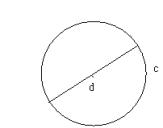
For example, no matter what cultural values you may have, a set of points equidistant from a given point has a definite shape (which we call a circle) with certain universal properties: the length around the circle (the circumference, c) is related to the diameter d as follows: c = d where is approximately 3.14159 |
|
(Notwithstanding the law passed early last century in Alabama that gave the value 3!)
Note that this is definitely a DISCOVERY, not an invention.
One way you can find a value of is to calculate the perimeter of a regular polygon withn sides, then let n get bigger and bigger.
(You should find that is the limit ofn sin (
 )as nbecomes infinite, and you can check
this by graphingy =x sin (
)as nbecomes infinite, and you can check
this by graphingy =x sin (
 )and having x go to 1000, say)
3.The Power of Algebra
Here's a simple example of how algebra (i.e. the use of letters to represent unknown quantities) can be used effectively to solve a problem:
(again, in my view largely because of either poor teaching or poorly designed courses, many have never had the opportunity to become familiar with this important tool)
Question A
Find 3 consecutive numbers whose sum is 42 ("consecutive" means "following each other"):
Step 1:describe the unknown quantities using a letter:
if the numbers are consecutive, we could call them
x, x+1, and x+2
Step 2:write a statement concerning these quantities:
x + (x+1) + (x+2) = 42
Step 3: solve :
so3x + 3 = 42(simplified)
so3x= 39(3 taken off each side to isolate x)
sox= 13(each side divided by 3 to get x)
Step 4: answer the question:
so the numbers
x, x+1 and x+2 that we wanted are13, 14 and 15.
It could be argued that algebra is not really needed in example A, which could be solved using common sense.
But the following example is rather difficult to do without algebra:
Question B
If 1000 NoK is invested for 12 years and becomes 3000 NoK, what is the average annual rate of interest achieved?
Step 1: let the interest as a decimal be x, then the money grows as follows:
Step 2: 1000(1+x)12 = 3000
Step 3: (1+x)12= 3(each side divided by 1000)
1+x= 3^(
 )(this is the 12th "root of
3",which a calculator can find)
)(this is the 12th "root of
3",which a calculator can find)
1+x= 1.0959 (next take 1 off each side to find x
so x = 0.0959,
Step 4: meaning that the rate of interest is 9.59% each year.
4.Now to those quadratic equations.
DON'T WORRY anybody can do this. I will show 4 different ways, each having different advantages, which I hope will convince you:
A quadratic equation looks like this: x2 - 4x + 3 = 0
We can solve this one by "factoring" as follows: (x-3)(x-1) = 0
so either x-3 = 0 or x-1 = 0, meaning thatx=1 or x=3
Or we can use a formula as follows:
x = = =1or3 as before
Or we can "complete the square" as follows
x2 - 4x + 4 = 1 (1 is added to each side, to make the left side a square)
so(x-2)2 = 1
so(x-2) = ±1
sox = 1 or 3 as before
Or with a GC, go to the menu "POLY"; key in "2" for "order"; then key in the coefficients 1, -4, and 3; then press "SOLVE" on the menu, and the answers 1 and 3 show up.
You need to know that NOT ALL quadratic equations can be factored, and that if your GC answers looks like this "(2,5)" and "(2,-5)", these are "complex numbers" - you will find out more about these in the presentation.
The Arts
THE ARTS
Please do these exercises BEFORE the class session on
Exercise 1
Look at the picture. How would you assess it as a piece of art? Write at most five sentences about this and send your answer to alex@alexmorgan.com Title your email as 'Art1'.
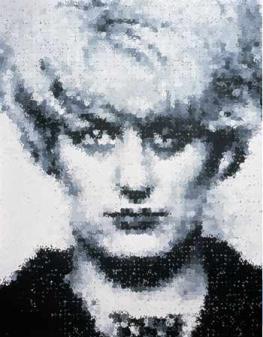
Exercise 2
Look at the picture. How would you assess it as a piece of art? Write at most five sentences about this and send your answer to alex@alexmorgan.comTitle your email as 'Art2'.
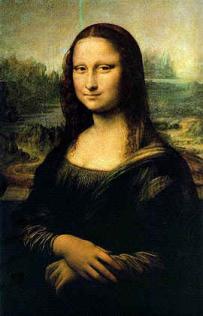
History
HISTORY
Read the text and answer the questions.
What is history?
History means both 'the past' and 'the study of the past.' As an Area of Knowledge the study of the past is different from Sciences in the sense that historical event are unique and unrepeatable. (Some sciences like biology though study unrepeatable events). History is not simply 'telling the story of past events' but contains always an element of interpretation. The earliest historiography (history writing) was simple chronicles of events, which later developed into narrative history and even later into analytical history. The difference between narrative and analytical history is important and will be explained below.
Like in sciences, there are many types of historical research depending on what time-period is being studied and which method and approach are being used. The period before written sources were available is called pre-history, and studied by archaeologists. They try to deduce what past humans thought, how they lived, what was important to them based on the artifacts left behind. . Historians proper concentrate on studying the period on which we have written records. However, written records are not the only 'sources' historians have - anything derived from a certain time-period can be used from architecture to artifacts.
Historiography is often a reaction to the intellectual climate of a given period. This is why it is said that 'each generation writes its own history.' For example, a decade or two ago environmental issues became important. At the same time historians started to do research on 'environmental history' in order to understand climate changes and the concept of environment of the past humans. At the time when postmodernism was (or is) the prevailing intellectual current, so-called 'micro history' - study of historical developments from individual's point of view - has become popular. One could say that many paradigms of history are based on the intellectual and cultural climate of a given time.
What do the Historians Do?
Probably the best way to understand history as 'Area of Knowledge' is to think of what historians do. Historians write accounts of past events in order to make them understandable. They start by studying 'sources' (texts, relics, pictures) with some hypothesis in their minds. This hypothesis can be formulated in many ways 'to what extent x caused y', 'what does x tell us about the belief system of society y', 'what were the patterns of environmental change in y based on evidence x' etc.
When historians report the results of their research they have to 'provide evidence' to in order to justify their claims. Providing evidence means that historian justifies the 'knowledge claims' (statements) he makes about the past by referring to sources. For example to say that Napoleon I was probably murdered is not a strong argument because evidence is not provided. It is better to say "Napoleon I was murdered by poisoning. At the time it was customary to attach clips of hair to letters. He sent several letters while he was kept as a prison on St. Helena and the chemical analysis of these samples of hair show an increasing levels of arsenic." - An even stronger argument would contain ideas of why he was murdered, by whom, and if there could be some other reason for the level of arsenic in his body when on St. Helena and so forth. Maybe some sources could give answers to these questions, in order to explain sufficiently what had happened.
All sources that are relevant to the argument must be mentioned in foot/endnotes, and a comprehensive list of references is attached in the end of the report in order to enable other historians to check if they could draw the same conclusions based on the given evidence. Much of historical debate concentrates on interpretations of sources and the amount of evidence needed to draw alleged conclusions. As the above example of Napoleon I shows, historians constantly need the help of other sciences (in this case chemistry) in analyzing the sources.
If one thinks about difficulties that link to 'correct' interpretation of source material, the fact that historians are products of a culture and doing their research in a particular time that is dominated by certain intellectual paradigms, and that they are heavily dependent on advances in other sciences in their analysis for sources - it is clear that it does not make sense to say that history can tell us the truth about the past, or that it could be 'objective'. However, history is no more or less 'objective' than any other science in the sense that human understanding of 'sense-data' and conceptualizing necessarily involves an element of interpretation.
To answer the question what the historians do one could maybe say that they "interpret the relics left by past humans in order to understand the past events." There are no set methods for historical research. Each research poses its own particular challenges - although historians have practices that minimise the element of subjectivity in the process of interpretation.
Styles of Writing History?
The kind of history that most of us are familiar with is called 'narrative history.' This type of history reports past event in a form of a story. An example would be Wedgewood's book The King's Peace 1637 - 1641, which talks about King Charles I. She writes that this book "tells the story of the four eventful years which immediately preceded the Civil War ... intention is not to much to analyze the causes of the Civil War as to understand how the men and women of that time thought and felt, and why, in their own estimation, they acted as they did."
There is another type of writing history called 'analytic history.' This way of writing explains events in terms of impersonal and long-term causes such as changes in power-relationships or in the economic structures of society. Its explanation relies less on human agency (the actions of individuals) than it does on a detailed discussion of the fundamental structures of society - its institutions, economic foundations and modes of thought.
If one takes these two styles of writing history and looks at how historians have been reporting of their findings, the general pattern is that most history written since Antiquity (Herodotus) to the nineteenth century historians, of which one of the most important is Leopold von Ranke, history has been written in a narrative style. These reports concentrated on the doings of the political Èlite and did not pay much attention to social or cultural structures or everyday experiences of the masses. It was only during the 20th century, particularly among the Marxist historians, that the analytic style of writing started to become popular. The analytic approach is typical also for the so-called Annales school of historians in 1960s. They advocated an inter-disciplinary approach which analyzed the shaping of society by long-term trends (structure) and rejected event-centred history as relatively unimportant. Traditional narratives had little part to play in the search for 'total history'. In the attempt to reveal structures one might say that the Annales historians have gone too far in rejecting the importance of events with the result the an individual seems to disappear form historical reports (making the Annales historians works boring to read). Modern historiography attempts to marry the narrative and analytical approach.
Value of History?
If we ask a question about the value of history, we should also ask 'value for whom?' After all, are we talking about the value of history as a form of academic study? If so, do we discuss its value for school students, for university students, or for salaried historians? Can we assume that its value for each group is the same?
Value of history is often linked to the sense of roots and identity. As individuals our past experiences have shaped us as people and often they give us a sense of identity. In The Drowned and the Saved, Primo Levi commented on the importance to him of his memories of studying the poet Dante as he struggled to survive each day as a prisoner in the death camp of Auschwitz.
"They made it possible for me to re-establish a link with the past, saving it from oblivion and reinforcing my identity."
If history is important on personal level it can also be important on cultural or national level. The identities that modern nations have were created since the mid-19th century by glorifying (and falsifying) the past of a given nation and establishing 'invented traditions' as British historian Eric Hobsbawn calls them. Also myths have been used to create identity - sometimes with horrible results as became obvious in how the myths of the battle of Kosovo Field (1389) was used by Seribia to justify the war in Kosovo in 1990s.(1) Historical myths are dangerous and consequently one value of research of history has to do with exposing such myths, and showing how we make false analogies between past and present. Unlike sciences, historians cannot test their hypothesis, but have to draw their conclusions based on incomplete evidence with mixture of imagination and empathy being constantly aware that one is dealing with humans in their complexity.
Can We Learn From History?
In 1930's Adolf Hitler was able to enlarge the German territory because Britain and France chose to be diplomatic with him rather than taking a hard line. In 1938 Munich conference British Prime Minister Neville Chamberlain exchanged the sovereignty of Czechoslovakia to the promise that Hitler would not start war against Britain. This encouraged Hitler's expansionism and finally led to the Second World War.
Many think that if Britain had stood up to Hitler in Munich (or preferably earlier, say over the remilitarization of the Rhineland in 1936), then there would have been no invasion of Poland and the Second World War would have been avoided. Based on this experience some would say it is always a mistake to appease a dictator. Instead we should make no concessions to aggressive dictators but stamp on them at the first opportunity. But unfortunately there are a number of flaws in this kind of analogy, which suggest that politicians are unwise to act as if Munich provides a fundamental rule of foreign policy. The first is that the condemnation of Chamberlain and his predecessors fails to take into account the actual historical context. Appeasement was probably the only viable course of action up to and including 1938. British public opinion was opposed to war. British interests were not directly involved in the fate of Czechoslovakia.
Failing to put past events into their historical context makes analogies meaningless, and there have indeed been victims of what might be called the 'Munich Syndrome'. In 1956, the British PM Sir Anthony Eden came to the conclusion that Gamel Abdel Nasser, the ruler of Egypt, was a Middle Eastern version of Hitler. Eden interpreted Nasser's decision to nationalize the British-owned Suez Canal as a first step towards securing a stranglehold on the oil-supplies of the West. With the perils of appeasement fresh in his mind - he had been foreign secretary to Chamberlain - he decided to launch an airborne attack on the Suez Canal Zone in November 1956. In so doing, he alienated the United States, which simply rejected Eden's analogy. And with reason. In comparing Nasser to Hitler and Suez to Czechoslovakia in 1938, Eden had failed to take account of the entirely different historical circumstances. His analogy ignored the genuine grievances of Nasser over the legacy of colonialism. Under pressure from the USA, and in the background of threats from the Soviet Union, Britain (and her ally France) was forced to withdraw. The abject humiliation of his country, the breakdown in his already impaired health, and the sad evasions in his autobiography Full Circle, are all abundant testimony to the disasters, which befell Eden when he attempted to learn simplistic lessons from history.
This is not to say that some good does not come out of politicians applying their wayward analogies in the attempt to learn from the past. The Munich/Hitler analogy was applied to the Iraqi dictator Saddam Hussein and his invasion of Kuwait in 1990. The freeing of Kuwait under the American-led forces of the United Nations would be seen by many as good. But the problem is that politicians applying lessons from history are really just engaging in a game of Russian roulette. Sometimes they can be lucky, sometimes not. Success has little to do with the accuracy or otherwise of their analogies, which are generally never thought through anyway. History can help to understand political situations and effective diplomacy would probably be impossible without a firm understanding of the historical background of the countries involved. And, on an everyday level, political behaviour in a democracy must be informed by an historical perspective. When a political party in Britain, say, makes pledges to protect - or to reform - the National Health Service, then only a sense of history can give the voter an understanding of what the NHS is, what its aims were and how the parties treated it in the past.
Useful links:
Encarta Article on History and Historiography
Britannica Article on History and Historiography
Send your answers toalex@alexmorgan.com
Footnotes: (1) In 1389, at the battle of Kosovo Field, a multinational Christian force was defeated by the largely Islamic armies of the Ottoman empire. In the second half of the nineteenth century, the new kingdom of Serbia made use of the Kosovo, defeat to claim that the defeated leader, Tsar Lazar, was a Christian martyr who preferred a heavenly to an earthly crown. His glory was transmitted to the Serbian church and people, and that multinational army somehow became a Serbian one. And, by a further leap of fantasy, the concept of the holy nation of Serbia was used to justify expansionist ambitions at the expense of Albania. In 1986, Tsar Lazar's bones were exhumed and carried in grisly procession through Serbian villages with the intention of encouraging Serbs to fight their enemies. And their enemies were virtually everyone: the decadent West, the Roman Catholic Church, the Albanians, Croats, and Muslims. In 1989 - the 600th anniversary of Kosovo - a mass rally was held on the site of the battle. President Milosevic and his Generals exploited nationalist frenzy to propel Serbs into war against their former partners in Yugoslavia. The horrors of Bosnia were the direct result.
Ethics
ETHICS
Read the text and answer the questions.
What is Ethics?
Ethics is the study of arguments for moral beliefs (morality). Moral believes are believes about right and wrong. For example "killing a human is wrong" is a moral belief. Moral beliefs shared by the society are called norms. Our parents have taught many of norms to us in our childhood by telling us what to do and what not to do. When you have asked your parents to explain their do's and don'ts, you have asked them to provide a rational explanation for holdingcertain moral beliefs. This is precisely what we do in ethics: we want to see what is the argument for considering certain acts, act or principle as morally right or wrong.
Ethics is a normative ëscienceí, because it is concerned with moral norms, as distinguished from the formal sciences, such as mathematics and logic, and the empirical sciences, such as chemistry and physics. The empirical social sciences, however, including psychology, impinge to some extent on the concerns of ethics in that they study social behavior. For example, the social sciences frequently attempt to determine the relation of particular moral principles to social behavior and to investigate the cultural conditions that contribute to the formation of such principles.
What is Ethics About?
If I say, "Joniís car is green" I am making a descriptive statement. But if I say, "Joni has a good car" I am making a value judgment ñ much the same way as I am making a value judgment if I say "Joniís car is beautiful." Value judgments seem to ëaddí something to ëwhat isí. Imagine for example that you have witnessed a murder. You give a full description of events to the police after which you say "It was horrible and wrong!" If the police would ask you "exactly where did the wrong happen?" or "could you show me the horrible?" ñ you would think that she has probably gone mad because ërightnessí or ëwrongnessí are not things that you see in the same way as physical objects.
Because our moral beliefs seem to be of something over and above what can be perceived, some philosophers like A. J. Ayer think that moral judgments are about our emotions ñ how we feel about things. To say that something is wrong equals to saying you donít like it. This view is called emotivism. Another related view is to say that ethics is about our preferences ñ in some cultures some practices are acceptable that in some other cultures are not. For example in some cultures female circumcision is acceptable whereas in western cultures it would be considered as brutal and unacceptable. The view that morally right and wrong depends on culture is called cultural relativism. According this view we have no right to pass judgments about practices of other cultures, this would only be a form of cultural imperialism. The most extreme form of relativism is subjectivism. It says that moral judgments are relative to individual ñ there are no objective moral rules but whatever you regard as right or wrong is so. Thus according to these views ethics is either about my feelings, about my culture or about my opinions.
If any of the above views is true then it does not make much sense to ask "why" about our moral beliefs. The answers would be "because I like it", "because thatís what we do in our culture" and "because thatís what I think" - end of debate. However, we have moral debates in which we want to know reasons for holding one view rather than another. We think that it is rational to hold a view that has a best argument to support it. This is precisely what normative ethics is trying to do ñ find a rational rule we could apply to moral questions in order to do the right thing.
Three Theories of Normative Ethics?
Most theories of normative ethics are about our duty to do the right thing (deontological theories), doing what has best consequences (consequentialist theories) or doing what makes us better persons (virtue ethics). Most people are acquainted with so called Divine Command Theory, which says that morally right is to do with Godís commands. Many Christians for example think that if they "love their neighbor as themselves" and keep the Ten Commandments they are doing the right thing. Buddhists have the Eightfold Path as their moral guideline. There are all kinds of problems with the Divine Command Theory ranging form trying to prove Godís existence to knowing Godís will and interpretation of religious language.
Probably the most famous deontological theory comes from German philosopher Immanuel Kant. He tried to device a rational principle by which anyone could figure out what is the right thing to do. He called this principle the Categorical Imperative. In its most general form it says that you should always act according to the principle that you wish to become a universal law. This does not fall too far from what you mother (probably) used to tell you when you were naughty ñ "what if everybody did that?"
Letís imagine for example that you promised to be on time for a very important meeting. You were late but did not think much of it until your friend asks you "what would happen in a world in which people did not keep their promises?" You would soon understand that it would not make sense to promise anything at all in such a world ñ and consequently due to this logical contradiction (that itís ok for you not to keep your promises but not ok for everyone) you understand that what you are doing must be wrong. Kant says that once you have understood this it becomes your duty as a rational agent never to break a promise. By similar reasoning you can invent a whole collection of duties you think you should keep. However we can imagine situations in which these duties conflict with one another and Kant doesnít offer much help how to solve these annoying situations.
According to utilitarianism we should judge the question of morally right or wrong by thinking of consequences. The idea is that an act (or a principle) that produces "greatest happiness to greatest numbers [of people]" is the right one. Many utilitarians consider ëhappinessí as ëpleasureí and ëunhappinessí as ëpainí. Good life then is the life that maximizes everybodyís pleasure. When people say "whatever makes you happy, baby" and "whatever is good for you" they are really being utilitarians. The trouble with utilitarianism is that we cannot measure happiness (pleasure) or know what the consequences of our actions are in advance. As we all know often ëroad to hell is paved with good intentions.í
Greek philosopher and scientist Aristotle was not focusing so much to actions or principles as to what is happening to us as persons when we act in a certain way. If you ask yourself a question "what kind of a person would I be if I did that?" or blame yourself by saying "what have I become?" ñ you are thinking in terms of virtue ethics. You think that certain actions change your moral properties by making you ëa better personí or ëa worse person.í The virtues you can develop such as courage, love, trustworthiness, honesty and so forth grow according to Aristotle simply by acting virtuously. If you want to become courageous start doing things that are scary ñ jump to the ice-cold fjord or do that bungee jump. If you want to become generous ñ start donating money. The trouble with this theory is that in some situations virtuous acts can be the most horrible mistakes. Imagine that you have really worked with your virtue of honesty and become absolutely honest and upright person. If an axe murderer comes to ask your friend's address you would hardly do her a favour by being honest and providing correct information. Rather being good at lying would be more virtuous in this situation. Another problem is to decide what are the virtues and vices ñ the list can seem endless and contradictory.
Ethics and the Environment
Ethics of course is not only highflying theories but it is widely applied to real life situations. Applied ethicsregards complicated moral dilemmas such as abortion, euthanasia, cloning etc and tries to determine what would be the right thing to do in any given situation. During the last twenty years or so an important new field of applied ethics has emerged ñ environmental ethics. This ethics has pointed out that our thinking about morality has been much too human centered (anthropocentric) ñ as if other sentient beings on this planet or the natural resources would only be instruments to achieve human ends.
According to one of the more extreme ethical positionDeep Ecology we have no right to regard us as special creatures among other animals. On the contrary because we can think and make moral judgments we should use this capacity in the interest of all sentient beings not just humans. According to Australian philosopher (utilitarian) Peter Singer, who has been influential in launching the animal rights movement, all pain is intrinsically bad and we should not unnecessarily inflict pain on animals. Some like the Finnish eco-fascist Pentti Linkola go so far as to say that humans are a major problem on this planet: we waste resources, kill other species to extinction, burn down the rainforests, pollute and cause climate changes on a global scale. According to Linkola there are too many of us for the planet to sustain. Consequently he wishes that some nasty disease or war would wipe off a few billion humans. It would be good for the global ecosystem.
One of the leading Deep Ecologists is Norwegian philosopher Arne NÊss. Deep Ecology is an interesting combination of philosophy and beliefs about ecological facts. Many Deep Ecologists are active in campaigning and lead low waste and energy consumption lifestyles. In his book Ecology, community and lifestyle NÊss, who has become somewhat a cult figure among the environmentalists, outlines his thesis as follows:
From: Arne Naess, Ecology, community and
lifestyle,
Cambridge, 1989, CUP, p. 29.
NÊss regards life having an intrinsic value - something that has value in itself and does not require argument for it. Most readers of NÊss' thesis would find the point three "Humans have no right to reduce this richness and diversity except to satisfy vital needs" the most problematic since it seems to be saying that human life is after all more important than other forms of life. Other forms of life can be sacrificed in order to promote the survival of the humankind, even though NÊss goes on later to point out that it would be better for the ecosystem if there were fewer humans (Point 5).
The changes in ecosystem are a fact. Is it logically valid to take this fact and deduce from it some moral judgments like NÊss seems to be doing. Scottish philosopher David Hume would say no because "is does not imply ought." What he means that is it would be fallacious to argue from the way things are to how they ought or ought not to be (see 'naturalistic fallacy'). For example assuming that Darwin's idea of 'survival of the fittest' is correct. Can we from this fact conclude that we should not help the poor but rather let them die because they are not fit to survive by themselves? Taking NÊss' example - it is a fact that there are about six billion humans on this planet and that we compared to any other life form pollute, consume vast amounts of energy and kill other life forms. Can we from this conclude that it is right to let some humans die in the interest of the ecosystem like Finnish eco-fascist Linkola does? Hume would answer that such inferences from fact to value are fallacious. Facts in themselves do not contain any particular value - ecological crisis is a fact but to say that ecological crisis is bad and something should be done about it is a value judgement that requires an argument. Whether or not such an argument can be provided is debatable.
Useful
links:
http://encarta.msn.com/encnet/refpages/refarticle.aspx?refid=761555614
http://www.britannica.com/eb/article?eu=108566&tocid=0
http://www.utm.edu/research/iep/e/ethics.htm
Send your answers toalex@alexmorgan.com
[Under Construction]
FIRST YEAR EXAMS?
[Under Construction]
[Under Construction]
[Under Construction]
SUMMER READING
Summer Reading for TOK Students is: Robert M. Pirsig: Zen and the Art of Motorcycle Maintenance [Original link].
"The book tells a story of a motorcycle journey across America in which the author, who has had a nervous breakdown, gradually rebuilds his own life and his relationship with his 11-year-old son Chris, who is riding pillion. But that stark description doesn't even begin to scratch the surface of this philosophical "Easy Rider" of the 60s, a many-layered book, rich with anecdote, allegory and discussion of Greek and oriental philosophy."